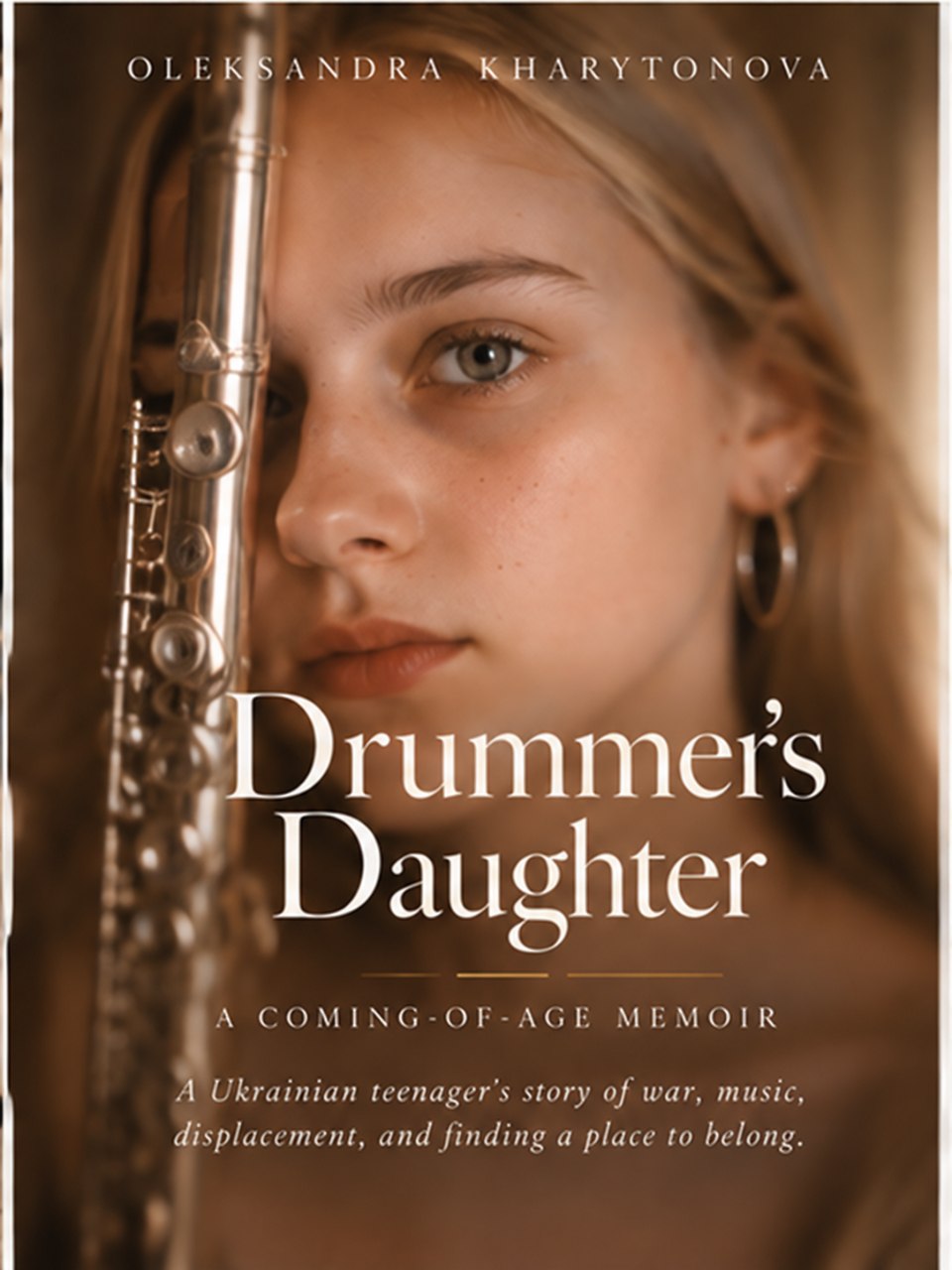
Boom.
Tak.
Tss-tak.
Boom. Tak. Tss-tak.
Da-ga-da-ga-da—dam.
The familiar rhythm of drums came from the next room, and I smiled. Dad was playing again.
To our neighbors, it probably sounded like noise. To me, it was the sound of home.
Continue Reading
My dad’s name is Denys, and for as long as I can remember, there have been drums somewhere near him. He was not self-taught. He had serious classical and jazz training with one of the best drum teachers in our city, and somehow, when he was young, he managed to study full-time at a music college and a pedagogical university at the same time. Luckily, the two schools were across the street from each other, so he literally ran from classes at one building to classes at the other. His teachers knew what he was doing and somehow supported this crazy schedule.
Maybe that training was why he always looked so controlled behind the drums. His back was straight, his movements precise, and even when his hands were moving incredibly fast, nothing about him looked rushed.
Outside music, Dad was different. He joked a lot, rushed from one errand to another, and had the kind of working hands that seemed able to fix almost anything. Sometimes I would find him sitting silently in the kitchen with coffee, headphones on, staring at something on his computer. But when he sat behind the drum kit, his attention narrowed completely. His hands seemed to speak a language he knew better than words.
Apparently, I noticed this very early.
When I was about one year old, Dad took me with him to a corporate event where he was performing with a well-known Ukrainian band. During sound check, he sat me nearby while he worked on his drums. Someone gave me a large round cookie to keep me occupied.
Instead of eating it, I placed the cookie flat on my knee and started tapping on it with both index fingers, imitating Dad’s snare drum rolls.
Everyone around me started laughing.
Someone recorded it, and later the video was uploaded to YouTube under the title “Cookie Drummer.”
If TikTok had existed then, I like to think I might have gone viral.
Years later, I could still sit near Dad while he practiced and watch him play for a long time. Sometimes he would glance at me and smile from the corner of his mouth without stopping.
I think his drums carried not only the rhythm of music, but the rhythm of our entire home.
Now, sitting in California and listening to him play again, I closed my eyes and suddenly saw Zhytomyr.
Our old apartment. Mom’s voice coming from the kitchen. Dad’s drums. A life that, back then, seemed as if it would last forever.
Outside my window in California, our elderly neighbor was walking his dog while the noisy neighbor downstairs was arguing with her husband again. Morning sunlight slipped through the blinds and left bright stripes across the floor.
But in my head, I was thousands of miles away.
My name is Oleksandra Kharytonova. I am sixteen years old, and I am the daughter of musicians.
There was almost never complete silence in our home.
If Dad was not playing the drums, he was tuning them, rearranging something in the kit, or quietly practicing rudiments on a rubber training pad. The drums themselves took up half a room, surrounded by speakers, microphones, cables, mixers, stands, and cases. Mixed in with all of it were my toys, activity books, coloring pages, and later, my school supplies. In our house, a microphone stand beside a box of crayons or a drum case next to my notebooks looked completely ordinary.
Mom created a completely different kind of noise.
She was always learning songs for upcoming concerts, writing something new, testing melodies out loud, or inventing vocal harmonies while doing something completely unrelated. She could make breakfast and learn a new song at the same time. She washed dishes while singing as if she were standing under stage lights, and sometimes in the evening she would turn on jazz in the kitchen, pour herself a glass of wine, and just listen.
Musicians from their band were constantly coming over too. Sometimes they rehearsed; sometimes they recorded something or sat around discussing arrangements. When I was very little, those were probably the moments when I first became familiar with a tablet, because someone would put cartoons on for me so the adults could work without me interrupting every five minutes.
Music played during breakfast. It played while Mom cooked. It came from Dad’s drums, from speakers, from instruments being tuned and songs being rehearsed.
Sometimes I felt as if I were living inside a musical.
In our family, music was not an activity we scheduled. It was simply how we lived.
Sometimes I think I was born somewhere between a rehearsal and a concert, and that is almost true. Mom performed until she was nearly eight months pregnant, and by the time I was two weeks old, she was already singing at a festival again.
When I was three, Mom and Dad left to work on a cruise ship for the first time. Their first contract lasted six months.
I remember sitting on the bed with my favorite teddy bear while Mom hugged me tightly, tears in her eyes. Before she left, she took a photograph of me sitting there, still sleepy and holding the bear.
I did not understand what six months meant.
I only understood that Mom was leaving, Grandma was crying, and so was I.
I still have that teddy bear today.
I missed both of my parents, but as a little girl I was especially attached to Mom. Dad loved me deeply, but he was quieter with his emotions. Mom was the person I reached for when I was tired, scared, sick, or sad, so her absence was the one I felt most sharply.
That first contract was only the beginning.
For roughly the next nine years, my parents spent long periods away from home, performing across Europe, China, the Middle East, the Baltic countries, and other places I first learned about because Mom and Dad happened to be working there.
During those years, Grandma Olena became almost a second mother to me.
She played Ukrainian songs on the radio and taught me to sing along. I still remember some of them. There was one especially sad song about cranes flying back home, and whenever it came on, Grandma and I sometimes ended up crying together because both of us were thinking about Mom.
About a month into my parents’ first contract, they sent money home for the first time. I remember Grandma seeming a little happier after that. We even started going out for lunch at small cafés more often.
I think it helped her understand that all this missing had a purpose.
As I got older, music became my life too.
When I was five, I started music school, and that was when the flute entered my life. First came lessons, then small concerts for parents, school recitals, children’s competitions, and rehearsals after school.
To be honest, I do not remember making some big decision that I wanted to become a musician. In our family, studying music seemed as natural as going to school or sitting down together for dinner.
It was everywhere: in our apartment, in the car, at my parents’ work, and in nearly every conversation.
I did not grow up only with music.
I grew up among musicians.
— End of excerpt —